
Christmas Gifts for Someone With Dementia: What Actually Gets Used
By K. Terry, author of fourteen bold & easy coloring books
Choose a gift that gives you something to do together rather than something to own. Large, simple pictures and gentle conversation prompts work better than anything complicated, anything noisy, or anything that asks the person to remember on demand.
Featured in this article
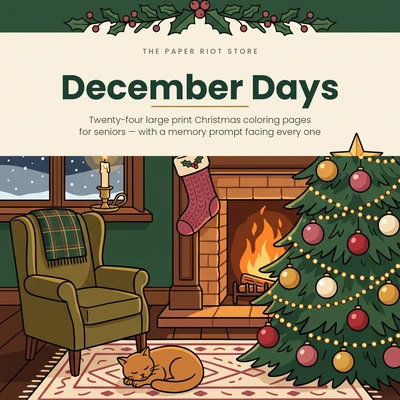
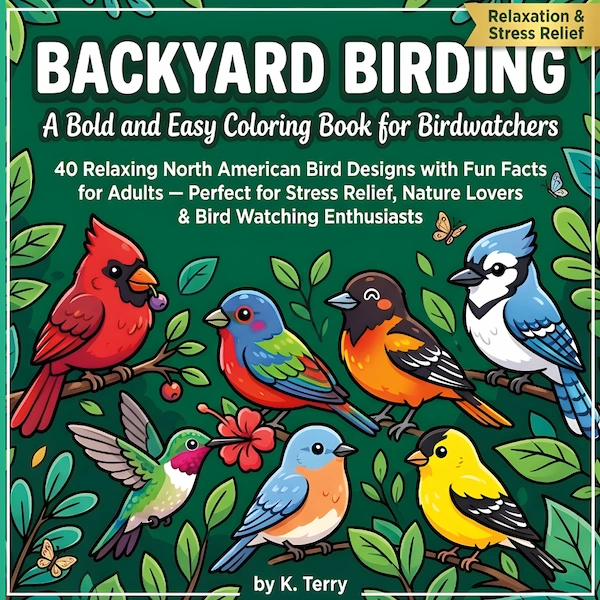
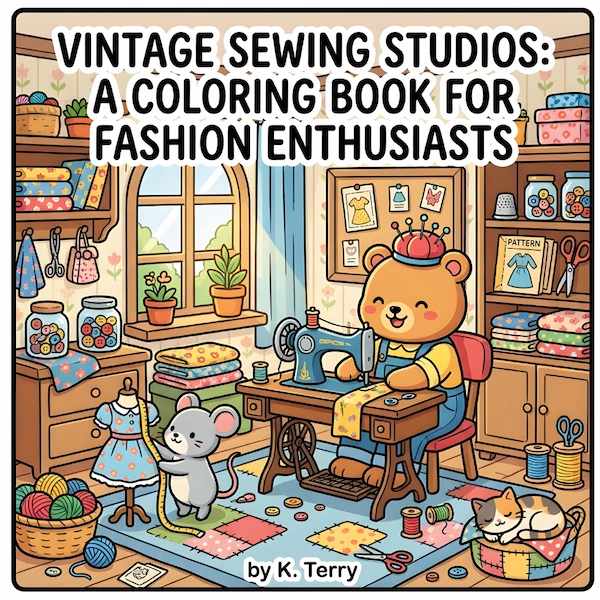
Christmas is the hardest day of the year for this, and almost none of the difficulty is about presents.
It’s the noise. The house full of people. The routine gone. Somebody who manages perfectly well on an ordinary Tuesday can spend the whole of Christmas Day quietly overwhelmed in the corner of a room, while everyone else assumes they’re enjoying themselves.
Which changes what a good gift is. The useful thing you can hand someone this year is not an object. It’s a reason to take them out of the loud room, sit down at a table with one other person, and do something quiet for half an hour.
Start with the half hour, not the present
Ask what the two of you will actually do with the thing after it’s unwrapped.
A sweater gets folded and put on a chair. A jigsaw needs a table nobody has spare on Christmas Day, and has a failure state built into it. A gadget needs learning, and learning is the thing that has become hard.
What works is something that starts immediately, can be stopped at any point without it being unfinished, and gives you both somewhere to put your eyes while you talk. That’s a low bar, and remarkably few Christmas gifts clear it.
Why the pictures need to be big
I’ve written before about what to look for in a coloring book for someone with dementia — the short version is thick lines, adult subjects, nothing that reads as childish.
For Christmas I’d add one more thing: size.
Most of my books are 8.5 inches square. The three newest ones — December Days, Mara at Home and Hymns of Grace — are 8.5 by 11 instead, and that’s deliberate. The bigger sheet gives me room for larger pictures with thicker lines, which is what older people and anyone with sight problems actually need.
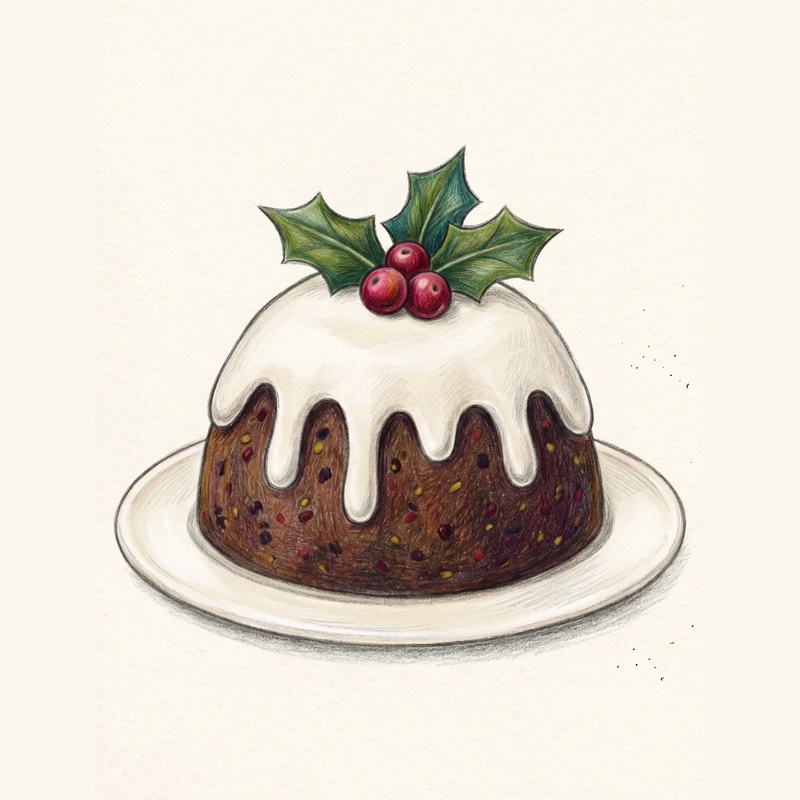
In December Days that means one object per page, drawn as large as the paper allows — a pudding, a robin, a stocking, a tree.
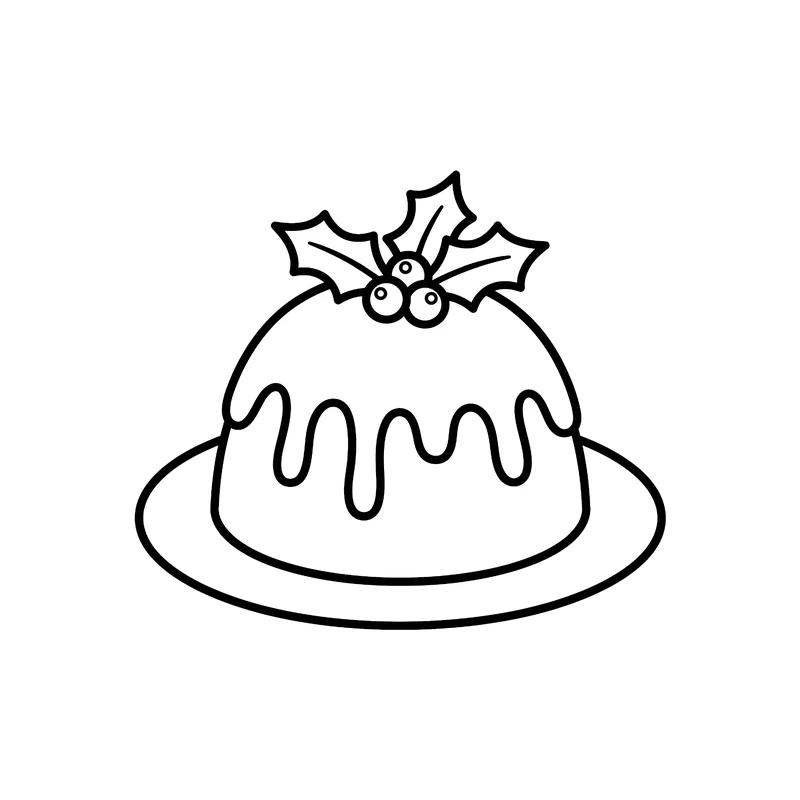
A page like that is easy to see across a table, which matters when two people are working on it together. It’s also easy to point at. When words are difficult, pointing at things carries a surprising amount of a conversation.
The questions are the actual gift
Every design in December Days has a memory prompt printed on the facing page. Not underneath the picture — opposite it, so one person can be coloring while the other reads.
Reminiscence prompts like these are widely used in care homes and day centers, and the reason is straightforward: memories from decades ago often stay reachable long after this morning’s have gone. A question about Christmas in 1962 can be a much kinder thing to ask than a question about breakfast.
But how you ask makes all the difference. This is the part most gift guides skip, and it’s the part worth getting right.
The University of Washington’s Memory and Brain Wellness Center puts it bluntly in their guidance for families: “Don’t try to drill memories to try to bring them back. Don’t test people to try to maintain their thinking.” Their suggested phrasing instead is simply “Tell me about…”
That distinction is small on paper and large at a kitchen table. “Do you remember the year we went to your mother’s?” is a question with a right answer, and not knowing it is a small failure, felt immediately. “Tell me about Christmas when you were small” has no right answer at all. It’s an invitation.
It’s why the book says on the page that there is no wrong answer. If a prompt about Christmas dinner produces a story about a dog from 1958, that’s the prompt working, not failing.
What to skip
Anything childlike. This is the trap, and it’s easy to fall into because children’s books have the right thick lines. The Alzheimer’s Association is direct about keeping activities on an adult level, and I’ve written about why that matters in more detail.
Anything that quizzes. Trivia games, “guess who this is” photo albums, anything with a score.
Anything noisy or complicated. Christmas Day already has too much going on. A gift that adds sound, or needs a manual, is working against you.
Recent photographs, handled carefully. Older photos are usually safe ground. Recent ones can raise questions about who has visited and who hasn’t, which is not a conversation anyone wants on the 25th.
If you’re the one doing the caring
There’s a good chance you’re reading this because you’re the person who will be managing the whole day — the cooking, the visitors, the moment when it all gets too much.
If so, be honest that the gift is partly for you. Half an hour at a quiet table, with something to do that isn’t a conversation you have to carry on your own, is worth as much to the caregiver as to anyone. Nobody hands you that. You have to build it into the day on purpose.
Pick something that takes twenty minutes. Sit down. Ask them to tell you about something rather than testing whether they remember it.
That’s the whole method, and it costs about ten dollars.
One honest note
Coloring is not a treatment. It doesn’t slow anything down, and I’d be careful of anyone selling it as though it might — there’s more on where I draw that line in my Christmas gift guide.
What it can do is give two people a table to sit at and something to look at together. On a day designed around noise and memory, that turns out to be worth a great deal.
Frequently Asked Questions
What should I buy for someone with dementia for Christmas?
Something you can do together, sitting down, one to one. Large-print coloring, a simple photo book, familiar music. Avoid anything with a learning curve, anything with small parts, and anything that quizzes them. The gift is really the half hour of company that comes with it.
Is it worth buying a gift if they won't remember opening it?
Yes. The half hour still happened, and the feeling of it tends to outlast the memory of it. This is one of the most common things caregivers ask themselves and it's worth answering plainly: you are not buying a memory, you are buying an afternoon.
Should I use memory prompts with someone who has dementia?
They can work well, but how you ask matters. The University of Washington's Memory and Brain Wellness Center advises: "Don't try to drill memories to try to bring them back. Don't test people to try to maintain their thinking." Invite rather than quiz. "Tell me about your Christmases" lands very differently from "do you remember Christmas 1974?"
What Christmas gifts should I avoid?
Anything childlike, however easy it looks. Anything that needs setting up or learning. Loud toys and gadgets, which add to a day that is already overstimulating. And recent photographs, which can prompt questions you may not want to have to answer on Christmas Day.
December Days
Twenty-four large-print Christmas pages, each with a memory prompt on the facing page. Made for care homes, day centers and kitchen tables.
See the book